
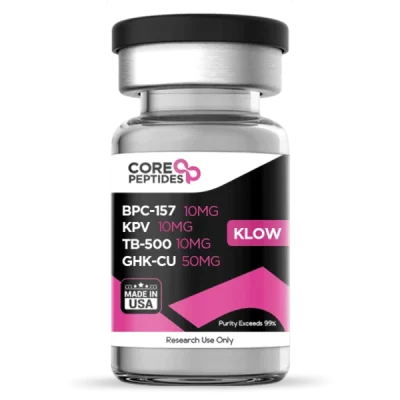
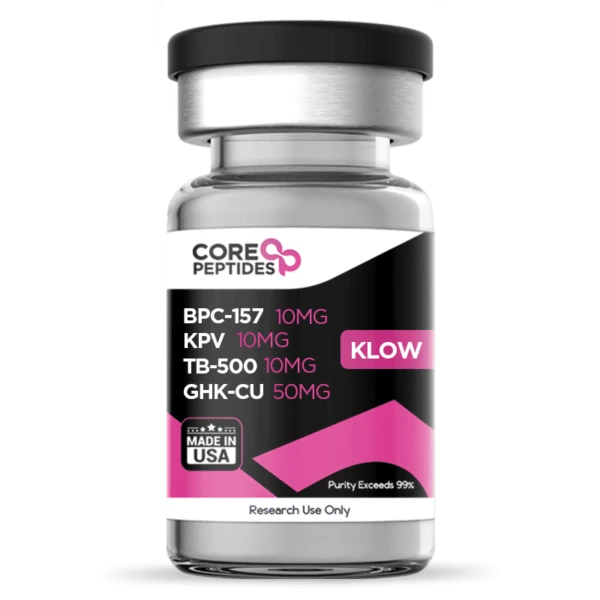
KLOW combines four extensively studied peptides, BPC-157, KPV, TB-500, and GHK-Cu, into a single multi-mechanism blend. Studies have explored KLOW’s potential in tissue repair, anti-inflammatory signaling, and collagen synthesis, specifically in regenerative research across skin and connective tissue models.
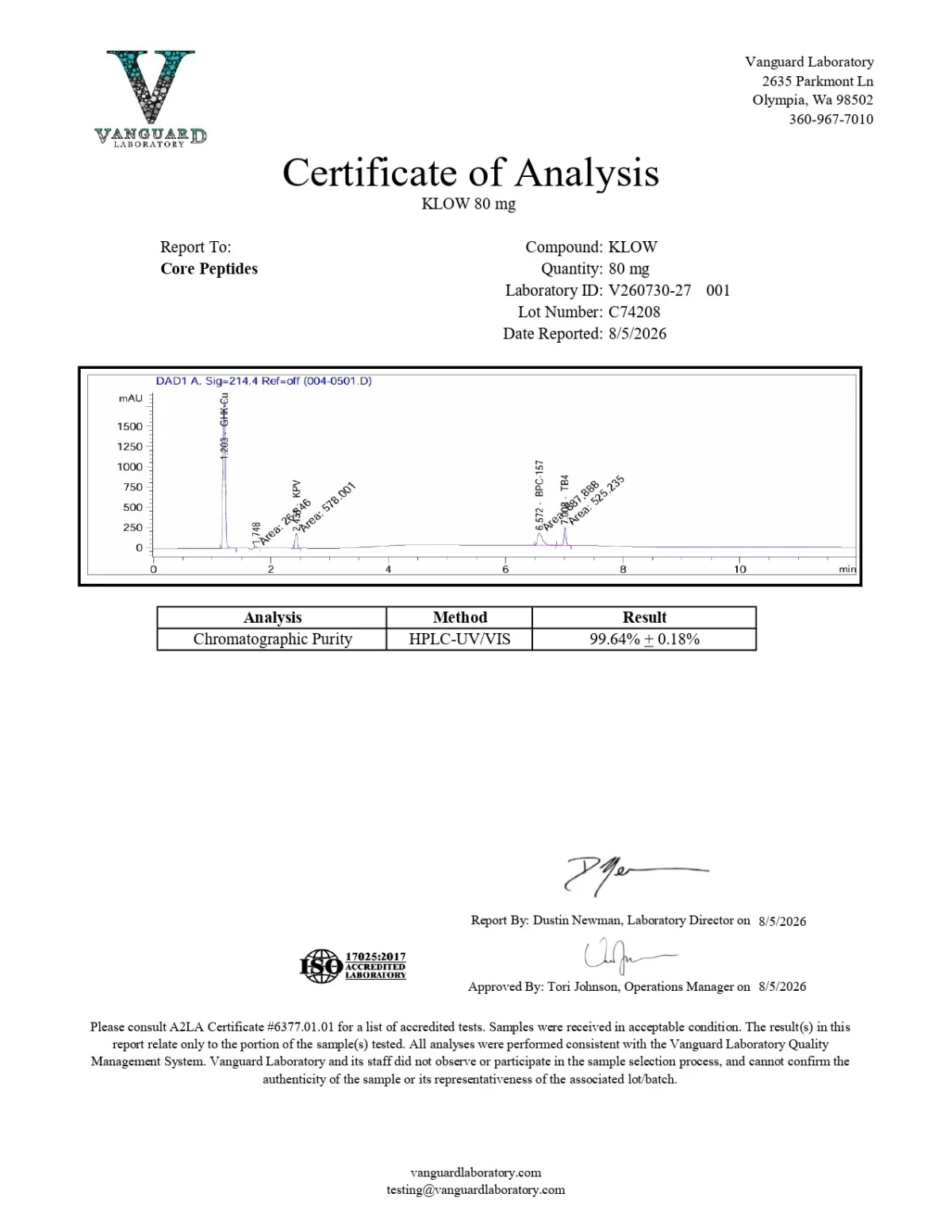
Every product is synthesized in the USA, and third-party lab tested for purity and consistency, with free shipping on orders over $200. Our products are intended for research and laboratory use; not for human consumption.
BPC-157 (10mg), KPV (10mg), TB-500 (10mg), and GHK-Cu (50mg)
BPC-157, TB-500, GHK-Cu, and KPV (KLOW blend) are peptides under investigation in laboratory models for their potential to support inflammatory signaling, angiogenesis, and repair mechanisms. Structurally, they differ considerably. BPC-157 appears to be a synthetic pentadecapeptide, TB-500 mirrors the endogenous thymosin beta-4, GHK-Cu is a tripeptide with a copper ion, and KPV represents the C-terminal segment of alpha-melanocyte-stimulating hormone.
Each peptide appears to converge on overlapping repair-associated processes, which supports the hypothesis that their combined exposure is the KLOW Blend. Together, these four peptides form what is referred to as the KLOW Blend, because their actions are hypothesized to be partly overlapping and partly complementary based on the available research data.
Chemical Makeup
Other Known Titles
- BPC-157: C62H98N16O22
- KPV: C16H30N4O4
- TB-500: C212H350N56O78S
- GHK-Cu: C14H23CuN6O4
Molecular Weight:
- BPC-157:5 g/mol
- KPV: 43 g/mol
- TB-500: 4963 g/mol
- GHK-Cu: 38 g/mol
Molecular Formula:
- BPC-157: Body Protection Compound-157
- KPV: MSH(11-13), ACTH(11-13), alpha-MSH(11-13)
- TB-500: Synthetic Thymosin Beta-4
- GHK-Cu: glycyl-L-histidyl-L-lysine-copper 2+
Research and Clinical Studies
KLOW Blend Peptides and Potential Properties
BPC-157 appears to be a synthetic peptide built from fifteen amino acids, with a potential parent protein remaining undefined. Laboratory models by the team of Sikiric et al. point toward a possible interaction between BPC-157 and intracellular signaling systems tied to vascular growth through angiogenic pathways and to inflammatory control through the dampening of pro-inflammatory cascades.(1)
TB-500 appears to be another synthetic peptide with a sequence that mimics the endogenously occurring thymosin beta-4. The molecule has drawn attention for its apparent involvement in cell migration, cytoskeletal arrangement, and inflammatory signaling. Data from cell culture experiments such as those by Maar et al. hint that TB-500 exposure may assist cellular movement and structural organization while also potentially engaging pathways connected to angiogenesis and the regulation of inflammatory mediators.(2)
GHK-Cu is a peptide complex made from the tripeptide GHK, composed of glycine, histidine, and lysine, joined to a divalent copper ion (Cu²⁺). Investigators such as Maquart et al. propose that the GHK sequence may arise endogenously as a signal that there is a process causing collagen breakdown, and repair is needed.(3)GHK-Cu is posited to function as a repair-associated signal that may engage fibroblasts, immune cells, enzymes, ion channels, and cell-surface receptors, with reported downstream potential over gene expression. Copper itself may be central to these potential actions, which may include collagen formation, adjustment of inflammatory signaling, and possible antioxidant activity.
KPV is a tripeptide made of lysine, proline, and valine, corresponding to the C-terminal segment of alpha-melanocyte-stimulating hormone (α-MSH). Research models by Böhm et al. suggest that KPV may carry much of the anti-inflammatory potential attributed to the larger α-MSH molecule while remaining a comparatively minimal fragment.(4) Potential mechanisms may involve reduction of NF-κB and MAP kinase signaling, and interactions with vasodilators like nitric oxide (NO), thereby possibly lowering pro-inflammatory cytokine output.
KLOW Blend and Anti-inflammatory Signaling
All four peptides are posited to occupy potentially complementary and partly overlapping positions within inflammatory signaling both inside cells and across the space between them. For example, laboratory work by Santra et al. suggests that TB-500 may reduce inflammation-linked signaling within cultures of developing brain support cells referred to as oligodendrocyte progenitor cells.(5)
When such cells encounter stress or injury, they are posited to switch on innate immune routes, particularly Toll-like receptor (TLR) signaling, which may fuel inflammatory activity inside the cell. The authors examined whether TB-500 may soften this signaling and suggested that the peptide may raise levels of miR-146a. This small regulatory RNA molecule may serve as an internal brake on inflammatory routes.
As miR-146a climbs, two central TLR signaling proteins named IRAK1 and TRAF6 may fall and consequently may fail to relay inflammatory signals through the cell, including routes tied to NF-κB activation that would otherwise weigh heavily on inflammatory output. Research by Sikiric et al. further suggests that BPC-157 may also engage inflammatory signaling by curbing the infiltration of inflammatory cells in laboratory models.(6)
When experimenting with the peptide, the investigators apparently recorded lower readings of biochemical markers associated with inflammation, among them indicators of neutrophil buildup, leukotriene B4, and thromboxane B2 within inflamed cell cultures. This peptide also appeared to adjust immune cell behavior, with reports of heightened macrophage activity that may steer inflammation toward resolution rather than persistence.
These outcomes reportedly emerged without direct suppression of specific cytokines such as TNF, which implies a more regulatory character. BPC-157 may “interact with the NO-system, providing endothelium protection,” which may indirectly restrain inflammatory amplification by keeping microvascular structure intact.
Further experiments by Park et al. indicate that GHK-Cu may also temper inflammatory signaling in macrophages roused by pro-inflammatory triggers and in models of cell injury.(7) Within activated macrophages, GHK-Cu apparently lowered intracellular reactive oxygen species and nudged superoxide dismutase activity back toward baseline.
The pro-inflammatory triggers apparently drove up TNF-α and IL-6 release, whereas GHK-Cu apparently pulled both cytokines down. The authors propose that GHK-Cu may have blunted NF-κB activation by reducing the activation of key regulators. KPV may round out the anti-inflammatory profile of the KLOW Blend through a distinct route, as suggested by laboratory work by Dalmasso et al., who posit that KPV may enter epithelial and immune cell cultures through the PepT1 transporter and, once inside, may suppress inflammatory signaling.(8)
Specifically, in cultured epithelial cells stimulated with IL-1β, evaluating the peptide alongside KPV apparently slowed the degradation of IκB-α and shortened the window of NF-κB activation, which may indicate a more restrained inflammatory response. The peptide also apparently reduced IL-1β-driven phosphorylation of ERK1/2, JNK, and p38, pointing toward broad dampening of MAP kinase signaling. In parallel, KPV apparently lowered IL-8 output, and in immune cell cultures stimulated with TNF-α it apparently preserved IκB-α while trimming IL-8 messenger RNA.
KLOW Blend and Extracellular Matrix Proteins
Multiple experiments with each peptide also suggest possible support for the regeneration and repair of extracellular matrix proteins (ECM) such as collagen and other supporting structures within cell cultures. As an example, research on TB-500 by Xu et al. suggests that the peptide may reinforce structural organization in models of recovering tendon fibroblasts.(9) The investigators apparently observed collagen fibers aligned more uniformly along the ligament axis and spaced more evenly in exposed cultures than in control cultures that were not exposed to the peptide.
Electron microscopy results also suggested larger collagen fibril diameters, a feature tied to better-supported mechanical properties. These structural shifts apparently coincided with greater tensile strength and stiffness in the recovered tendon structures. On this basis, the researchers posit that TB-500 may support how ligament fibroblasts organize and lay down collagen during repair and thereby support tissue quality.
BPC-157 may also assist repair by supporting tendon fibroblasts, as research by Chang et al. reports quickened fibroblast migration and spreading in laboratory studies, both of which are essential for repopulating an injury site.(10) The peptide apparently offered better fibroblast survival under oxidative stress, a condition commonly present in injured tendon cell cultures.
At the cellular level, these outcomes were posited to relate to the upregulation of actin fiber formation, which may have a synergistic potential with TB-500. The researchers commented that “F-actin formation as detected by FITC-phalloidin staining was induced in BPC 157-exposed cells. The activation of focal adhesion signaling through phosphorylation of FAK and paxillin is also posited to assist cell attachment and movement within the extracellular matrix and thereby facilitate repair.
GHK-Cu may additionally promote collagen synthesis, particularly at the interface between tendon cells and bone cells. Research by Fu et al. suggests that laboratory models exposed to the complex may indicate better-supported bone cell growth around tendon cell grafts and a trend toward greater cell presence inside the graft structure.(11)
KPV may also contribute to the collagen and repair dimension of the KLOW Blend by quieting the inflammatory environment that often accompanies tissue damage in culture. Because KPV apparently curbs NF-κB and MAPK signaling and lowers pro-inflammatory cytokine release, it may help create conditions under which fibroblast activity and matrix deposition may continue with less inflammatory interference.(8) Reports on the α-MSH family more broadly also suggest that Lys-Pro-Val may ease fibroblast stress in dermal cell injury models, which points toward a possible supporting role in structural repair.(4)
KLOW Blend and Tissue Regeneration
Beyond their apparent calming action on inflammatory signaling, the peptides have been posited to support cellular regeneration through varied mechanisms that ultimately reinforce vascularity and the delivery of nutrients to cellular structures. Notably, TB-500 in particular has been posited to favor cellular regeneration by supporting cell mobility and thereby encouraging angiogenesis. Research by Lv et al. suggests that TB-500 may shape cell movement as it binds globular actin (G-actin) and may adjust how actin filaments assemble to plausibly render cells more capable of changing shape, migrating, and organizing into multicellular structures.(12)
Such motility is a baseline requirement for sprouting angiogenesis, where vascular cells must advance into hypoxic tissue and arrange themselves into fresh tubes. The peptide reportedly raised cell viability and migration and increased tube formation on matrices, a common laboratory proxy for angiogenic behavior.
TB-500 also appeared to lift expression of angiogenesis-linked factors such as VEGFA, angiopoietin-2 (Ang2), and the Tie2 receptor. Mechanistically, the study by Lv et al. posits that TB-500 may drive angiogenesis through a Notch to NF-κB signaling axis. TB-500 may therefore be hypothesized to encourage angiogenesis by pairing a cytoskeleton-linked rise in endothelial motility with signaling shifts that elevate pro-angiogenic programs such as VEGF-A and Ang2/Tie2 through Notch/NF-κB coupling in damaged cellular structures.
Further research by Sikiric et al. also suggests that BPC-157 may aid angiogenesis and, in turn, cellular regeneration.(13) The peptide may act indirectly by steadying the vascular setting required for new vessel growth. Across several injury models, the investigators observed that the peptide may work by shielding endothelial cells and preserving vessel patency. Such endothelium protection may set up conditions in which endothelial sprouting and maturation may proceed.
At the cellular level, BPC-157 has been linked to the activation of repair-associated signaling routes, including Egr-1 with its regulator NAB2 and FAK–paxillin signaling, which may participate in cell adhesion and migration. The peptide has additionally been associated with normalized NO signaling under both excessive and suppressed NO states, offsetting the consequences of NOS blockade and NO overproduction.
Because NO is posited to govern vasodilation, endothelial survival, and angiogenic signaling, this balancing may support perfusion of injured cellular structures and facilitate endothelial activation and vessel remodeling. Additional investigations by Bonfiglio et al. have evaluated whether the KPV peptide may also support the repair of tissue models, specifically examining the potential mediating role of NO, similarly to BPC-157. (14)
Specifically, the researchers experimented with laboratory models featuring mechanically induced abrasions and suggest that the peptide may quicken the recovery of the tissues. Specifically, they commented that all models exposed to KPV achieved complete structural regeneration within 60 hours, whereas control models failed to reach full closure in the same period. This reparative action was apparently blocked when a mitigator of nitric oxide synthase was also added to the experiment.
Research on GHK-Cu by Mulder et al. likewise suggests that the peptide may upregulate VEGF, raise endothelial cell proliferation, and encourage endothelial migration and tube formation.(15) These actions are posited to also align with the stimulation of angiogenesis. Copper itself may also serve as a required cofactor for several angiogenic enzymes and transcriptional programs, and the GHK peptide appears to deliver copper in a biologically functional form at sites of cellular injury.
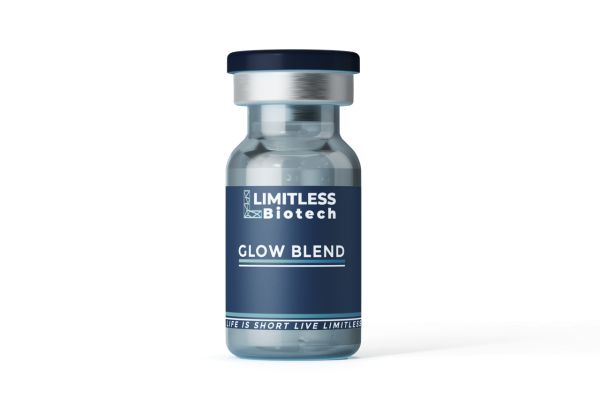
KLOW (BPC-157 (10mg), KPV (10mg), TB-500 (10mg), and GHK-Cu (50mg)) Blend is available for research and laboratory purposes only.
Reviews
There are no reviews yet.