
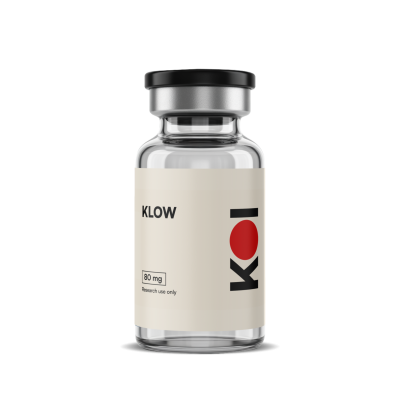

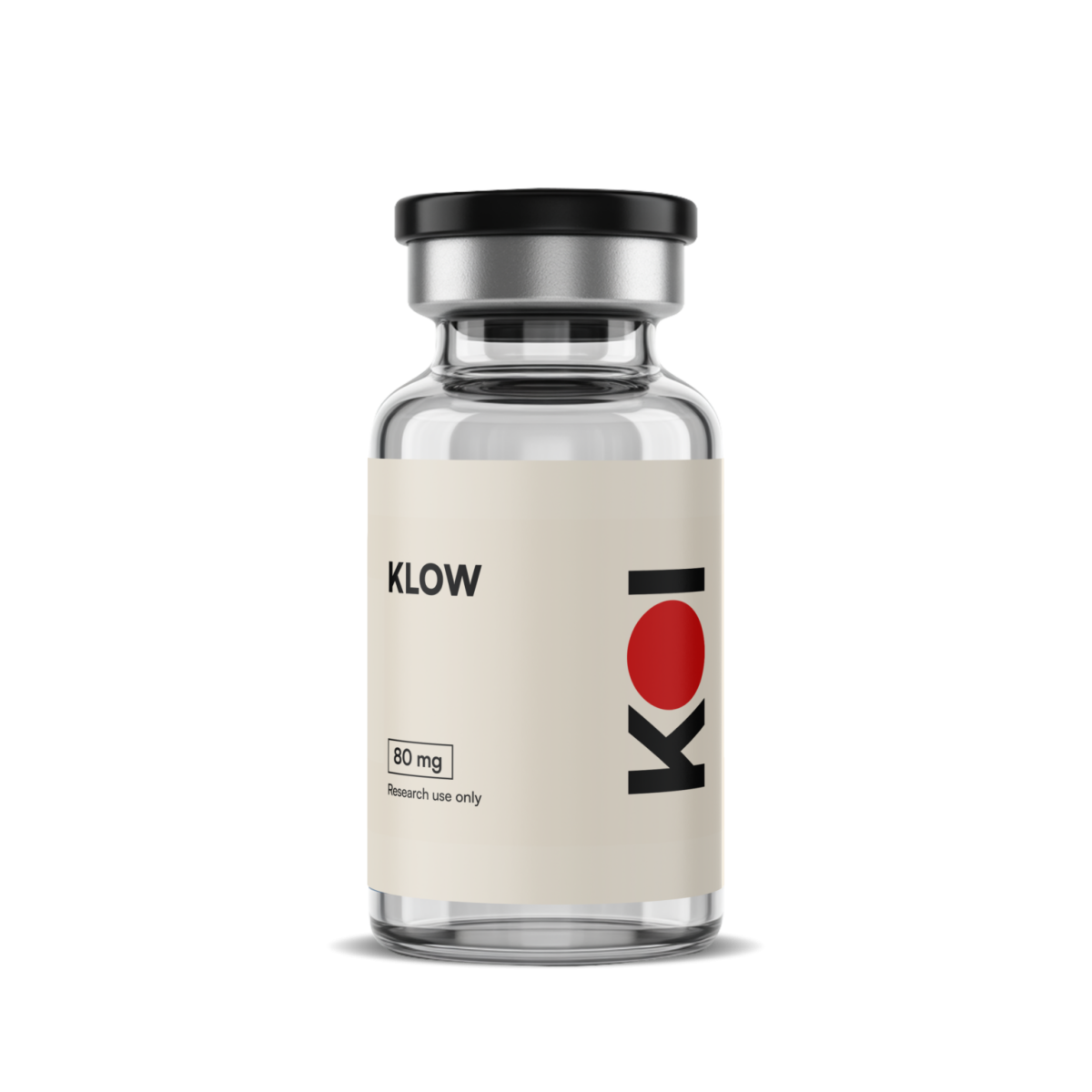
This product name (e.g. GLOW, KLOW, Wolverine) is only an informal catalog nickname, used so researchers can find this blend. It is not a claim of any cosmetic, beauty, skin, anti-aging, or therapeutic benefit. Supplied strictly for laboratory research use only — not for human, veterinary, cosmetic, or therapeutic use.
A four-peptide research blend combining BPC-157, GHK-Cu, TB-500, and KPV in a single sterile lyophilized vial for in-vitro study.
KLOW Blend is a research-grade four-peptide blend supplied in a single co-lyophilized vial — BPC-157 (10 mg), GHK-Cu (50 mg), TB-500 (10 mg) and KPV (10 mg), 80 mg combined. The four components span distinct structural classes and non-overlapping pathway layers: BPC-157 for angiogenic and growth-factor signaling, GHK-Cu for copper-mediated extracellular-matrix and collagen biology, TB-500 (Thymosin Beta-4) for actin-driven cell migration, and KPV (the C-terminal α-MSH fragment) for NF-κB and inflammatory-cytokine modulation.
Research areas where laboratories buy KLOW for in vitro work include multi-peptide signaling across angiogenic, anti-inflammatory and tissue-repair pathways, single-peptide versus multi-peptide comparisons on fibroblast migration and ECM organization, NO / VEGFR2 and FAK-paxillin pathway activity, and NF-κB pathway modulation. The material supplied here is research-grade for in vitro laboratory study only.
Every lot, independently verified
Compound information
Chemical & structural reference data — specifications, molecular profile and handling.
KLOW Blend Mechanism of Action
- BPC-157 engages angiogenic and growth-factor signaling — VEGF/VEGFR2, FAK-paxillin, and nitric-oxide pathways in fibroblast and vascular models.
- GHK-Cu chelates Cu²⁺ and modulates collagen, decorin, and matrix-metalloproteinase gene expression in dermal fibroblast cultures.
- TB-500 binds monomeric G-actin via the LKKTETQ motif, modulating the actin pool available for cytoskeletal remodeling and cell migration.
- KPV, the C-terminal α-MSH fragment, modulates NF-κB signaling and inflammatory-cytokine response in cell-based models.
- The four components span distinct structural classes and non-overlapping pathway layers — signaling, ECM remodeling, cytoskeleton, and inflammation.
- Studied as a multi-peptide reference system for how angiogenic, anti-inflammatory, and tissue-repair pathways interact in shared assays.
KLOW Blend Research Applications
- Modeling of multi-peptide signaling across angiogenic, anti-inflammatory, and tissue-repair pathways in in-vitro systems.
- Comparative studies of single-peptide versus multi-peptide activity on fibroblast migration, proliferation, and ECM organization.
- Nitric-oxide (NO), VEGF/VEGFR2, and FAK-paxillin pathway activity in cell-culture models of soft-tissue repair using BPC-157.
- NF-κB pathway modulation and inflammatory-cytokine response in cell-based models using KPV.
- Gene-expression changes in dermal fibroblast cultures exposed to GHK-Cu — collagen, decorin, and matrix-metalloproteinase regulation.
- Actin-binding and cell-migration activity of Thymosin Beta-4 (TB-500) in wound-healing research models.
- Each lot is tested by HPLC for purity, LC-MS for identity confirmation, and endotoxin assay for sterility readiness.
- The lot ID is printed on every vial and ties back to a public COA library, so researchers can verify documentation before they buy and after the vial arrives.
Reviews
There are no reviews yet.