

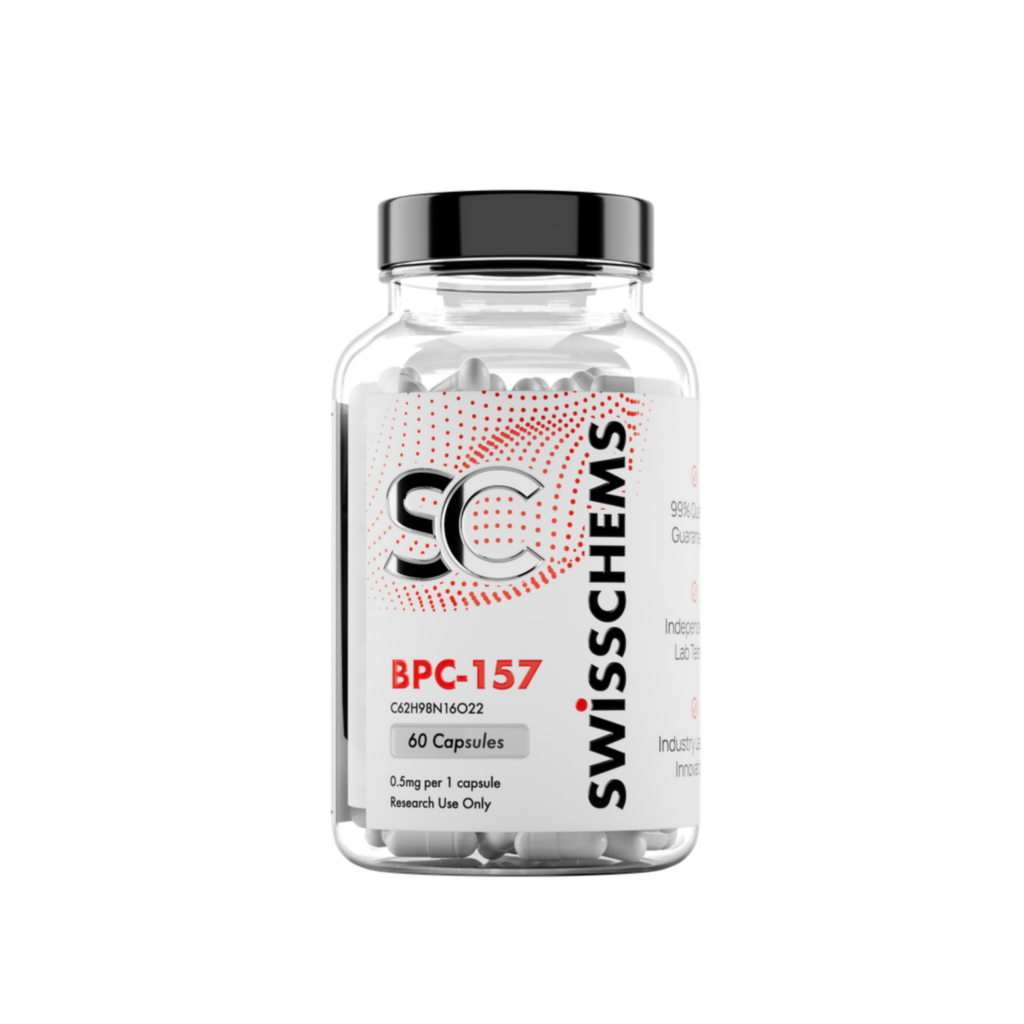
BPC-157 is a synthetic 15-amino-acid pentadecapeptide studied for its interactions with signaling pathways associated with angiogenesis, extracellular matrix regulation, and cellular migration. Experimental investigations have reported effects on VEGFR2 phosphorylation, focal adhesion kinase (FAK) activation, ERK1/2 signaling, and nitric oxide-associated regulatory pathways. These observations have made BPC-157 a useful research tool for examining peptide-mediated signal transduction, cytoskeletal organization, extracellular matrix dynamics, and the coordination of complex cellular signaling networks.
- High Purity – 99% Purity Guaranteed
- Independently Lab Tested
- Research Grade Quality
- For Laboratory Research Use Only
| Chemical Formula | C62H98N16O22 |
|---|---|
| Synonyms | Body Protection Compound 15, Bepecin, L-Valine, glycyl-L-alpha-glutamyl-L-prolyl-L-prolyl-L-prolylglycyl-L-lysyl-L-prolyl-L-alanyl-L-alpha-aspartyl-L-alpha-aspartyl-L-alanylglycyl-L-leucyl- |
| Molar Mass | 1,419.5 g/mol |
| CAS Number | 137525-51-0 |
| PubChem CID | 9941957 |
| Total Compound Content | 30 mg (0.5 mg per capsule) |
| Shelf Life | 36 months |
BPC-157 (Gly-Glu-Pro-Pro-Pro-Gly-Lys-Pro-Ala-Asp-Asp-Ala-Gly-Leu-Val) is a synthetic pentadecapeptide investigated for its interactions with signaling pathways involved in angiogenesis, extracellular matrix regulation, and cellular migration. The compound is notable among research peptides for its biochemical stability and well-characterized signaling profile, with experimental studies reporting modulation of VEGFR2 phosphorylation, ERK1/2 activation, focal adhesion kinase (FAK) signaling, and nitric oxide-associated regulatory pathways. These interactions position BPC-157 as a useful research tool for examining peptide-mediated signal transduction and pathway-specific cellular responses. Additional investigations have explored the relationship between BPC-157 and cytoskeletal organization, extracellular matrix dynamics, collagen-associated signaling networks, and cellular migration mechanisms. Experimental models have also examined its influence on signaling pathways associated with matrix remodeling and intracellular regulatory processes, contributing to ongoing research into the coordination of angiogenic signaling and extracellular matrix biology. Research applications include angiogenesis pathway investigation, connective tissue signaling, cytoskeletal regulation, and mechanistic studies of peptide-mediated cellular communication networks. Independently third-party HPLC-tested; COA available per batch.


Reviews
There are no reviews yet.