
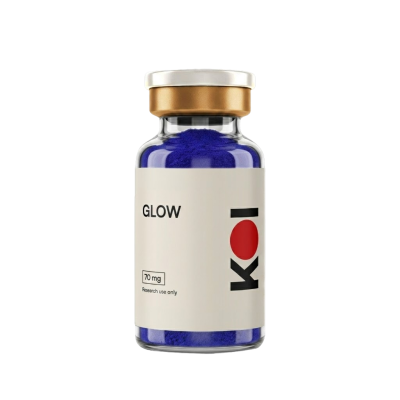

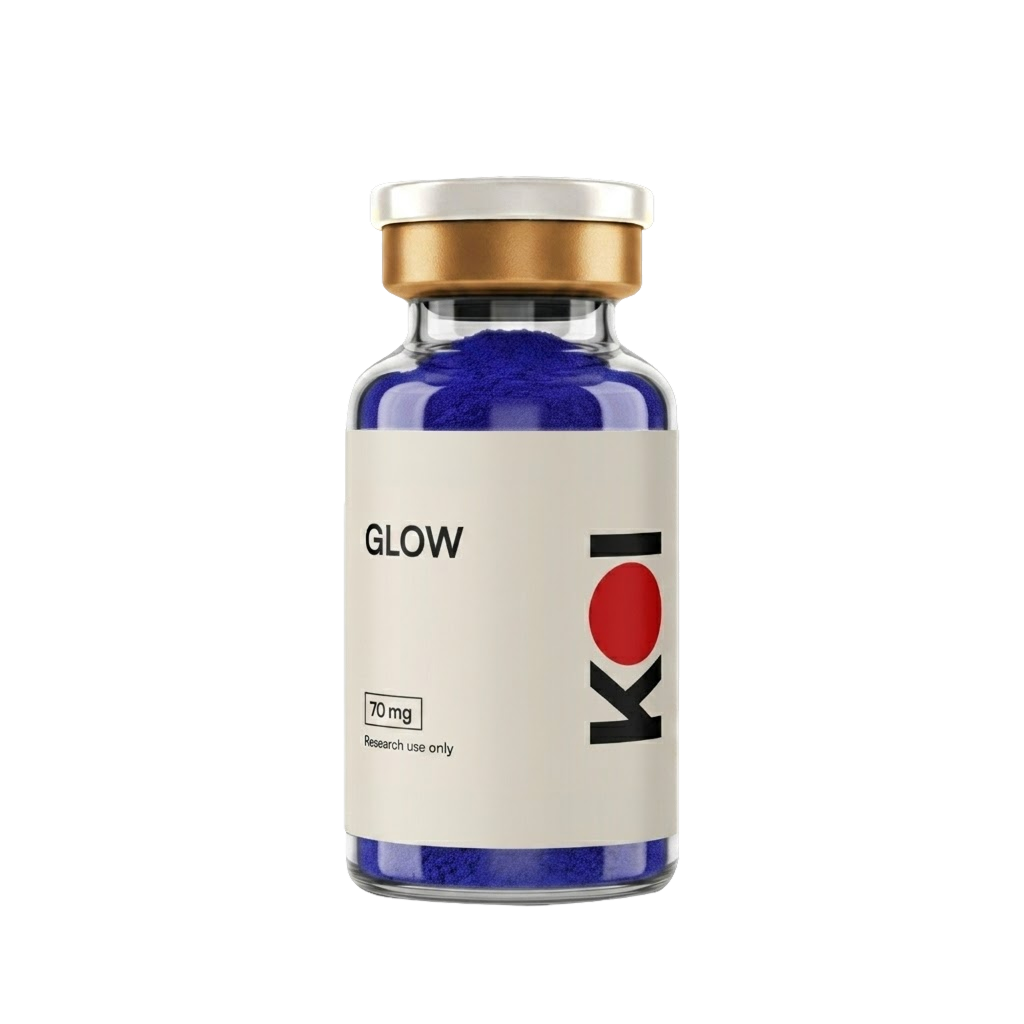
This product name (e.g. GLOW, KLOW, Wolverine) is only an informal catalog nickname, used so researchers can find this blend. It is not a claim of any cosmetic, beauty, skin, anti-aging, or therapeutic benefit. Supplied strictly for laboratory research use only — not for human, veterinary, cosmetic, or therapeutic use.
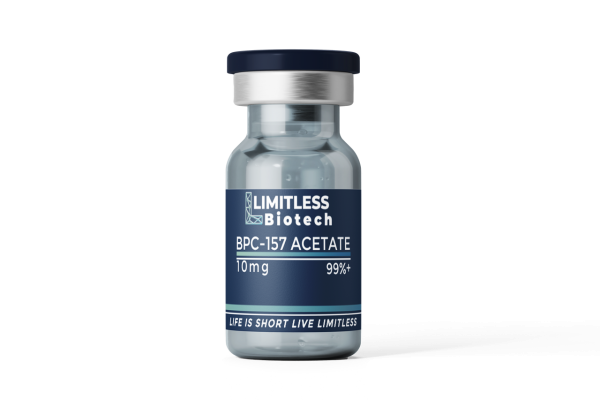
Three research peptides in one vial — GHK-Cu (50 mg), BPC-157 (10 mg) and TB-500 (10 mg): 70 mg of sterile lyophilized powder for in-vitro tissue-repair and matrix research.
What is GLOW Blend?
GLOW Blend is a research-grade three-peptide repair blend supplied in a single co-lyophilized vial — GHK-Cu (50 mg), BPC-157 (10 mg) and TB-500 (10 mg), 70 mg combined. Each component is studied for a different layer of the regenerative cycle: GHK-Cu for copper-mediated extracellular-matrix and collagen signaling, BPC-157 for angiogenic and growth-factor pathways, and TB-500 (acetylated Thymosin Beta-4) for actin-driven cell migration.
Research areas where laboratories buy GLOW for in vitro work include how the three peptides interact at fibroblast signaling and extracellular-matrix deposition, single-peptide versus multi-peptide comparisons on fibroblast migration and proliferation, NO / VEGFR2 and FAK-paxillin pathway activity in soft-tissue-repair models, and copper-mediated antioxidant-pathway profiling. The material supplied here is research-grade for in vitro laboratory study only.
Every lot, independently verified
Compound information
Chemical & structural reference data — specifications, molecular profile and handling.
- GHK-Cu — copper-bound tripeptide studied for collagen, decorin and matrix-metalloproteinase gene expression in dermal fibroblasts.
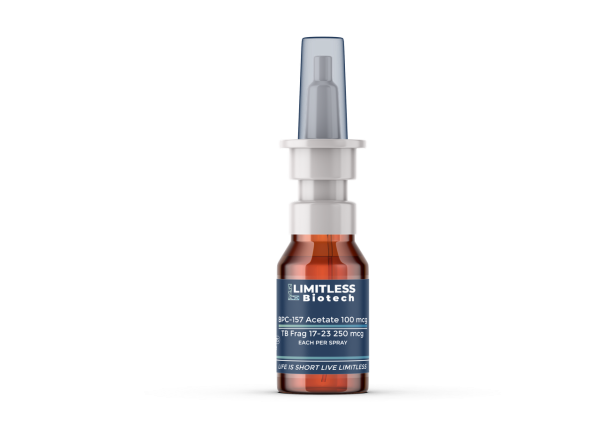
- BPC-157 — pentadecapeptide studied for NO / VEGFR2 and FAK-paxillin pathway activity in soft-tissue-repair models.
- TB-500 — acetylated Thymosin Beta-4 studied for actin-binding and cell migration in wound-healing and cardiac models.
- Together the three are studied across distinct stages of the regenerative cycle — matrix remodeling, angiogenic signaling and cell migration.
GLOW Blend Research Applications
- How GHK-Cu, BPC-157 and TB-500 interact at fibroblast signaling and extracellular-matrix deposition in vitro.
- Gene-expression changes in dermal fibroblast cultures — collagen, decorin, matrix-metalloproteinase regulation.
- Nitric-oxide (NO), VEGF / VEGFR2 and FAK-paxillin pathway activity in soft-tissue-repair models.
- Actin-binding and cell-migration activity of Thymosin Beta-4 in wound-healing and cardiac-tissue models.
- Single-peptide vs multi-peptide activity on fibroblast migration, proliferation and ECM deposition.
- Copper-mediated antioxidant-pathway activity and comparative stability of the three peptides.
- Each lot is tested by HPLC for purity, LC-MS for identity confirmation, and endotoxin assay for sterility readiness.
- The lot ID is printed on every vial and ties back to a public COA library, so researchers can verify documentation before they buy and after the vial arrives.
Reviews
There are no reviews yet.